
Piet de Weerd was more than just a pigeon enthusiast.
He was a visionary, someone who understood the sport of pigeon racing on a deeper level.
At the core of his philosophy was the idea that success wasn’t just about brute strength or speed, but rather a subtle balance of vitality, energy, intuition, and intelligence.
For De Weerd, pigeons weren’t just competitors in races, but creatures that instinctively engaged in the art of flight, driven by a natural sense of survival.
The key to success wasn’t simply in physical power but in the inner qualities of the bird—their intuition, resilience, and inherent ability to race.
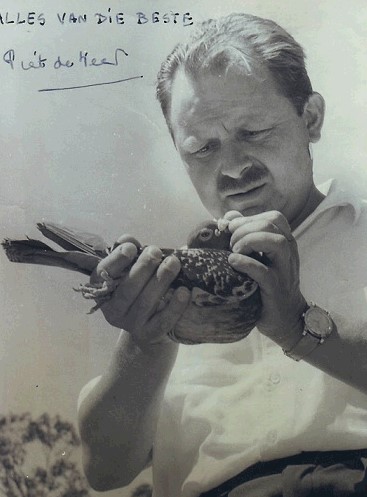
De Weerd was a master at selecting and pairing pigeons, understanding that the success of a loft was not based on luck or superficial observations.
For him, the strength of a good pigeon lay in the refined details: the structure of the muscles, the ability to store energy reserves, and the quality of muscle tissue.
He saw a pigeon’s vitality as a combination of physical strength and inner aggression, a form of defiance that he described as a survival instinct.
According to him, a pigeon without that aggression was simply worthless; it lacked the will to survive, the strength to face natural forces head-on.
This instinctive resistance, this stubbornness, was the essence of what made a pigeon successful.
De Weerd also introduced an intriguing distinction between ‘wet’ and ‘dry’ pigeons.
Wet pigeons, which he described as clammy and silky soft to the touch, had better water balance and were healthier overall.
These pigeons, capable of retaining moisture despite not having sweat glands, were better equipped to perform under harsh conditions.
His idea of the ‘wet’ pigeon is a perfect example of how De Weerd focused on details that others often overlooked.
He stressed that good pigeons came from healthy lofts, where the balance of humidity was optimal, and ventilation was properly maintained.
Poor lofts, with bad humidity levels and overcrowding, led to dry, dull pigeons with poor feather quality.
These small nuances, in De Weerd’s view, were crucial for success in pigeon racing. A dry pigeon, no matter how sharp its eyes might be, would never perform as well as a wet, healthy pigeon that could cut through the air with energy and force.
In his vision, the essence of pigeon racing wasn’t solely about the birds’ physical training. While pigeons, like athletes, have muscles that need to be exercised, De Weerd believed that their inner strength, their vitality, was just as important as their physical condition.
He described the best pigeons as ‘walkers,’ pigeons that use their energy efficiently and have endurance that transcends mere physical power.
This idea parallels the training of human athletes, where mental and intuitive aspects are as crucial as physical preparation.
The most successful pigeons weren’t necessarily the fastest or the strongest but those with the right mental aptitude and physical balance.
De Weerd’s approach to selection and breeding reflected his unconventional philosophy. He often broke with common pairing practices, choosing combinations that seemed counterintuitive: pigeons with short breastbones and long tails, traits that other breeders would reject.
But De Weerd knew that these pigeons, precisely because of their unusual characteristics, had immense value for long-distance racing.
For him, what mattered most was not what was visible on the surface but what lay within the pigeon.
This showcased his deep intuition and his belief in the power of subtlety, something many others failed to grasp.
Vitality, energy, intuition, and strength were the core values that defined Piet de Weerd’s philosophy.
He understood that pigeons, like humans, were not one-dimensional beings.
Their success came from a complex mix of physical, mental, and intuitive qualities. His insights can be applied beyond pigeon racing.
He saw the importance of a holistic approach: strength isn’t just in muscles, speed isn’t just in wings, and vitality isn’t just in nutrition.
It’s about the right balance between energy, intelligence, and the instinct to survive—the qualities that enable a pigeon, or a person, to race and triumph.
His legacy isn’t solely in the many successful pairings he created but in his ability to make the invisible visible and emphasize the importance of intuition and individuality.
He taught pigeon enthusiasts to look beyond the surface and understand the true essence of the pigeon: a living being driven by an inner force that unites vitality, intelligence, and intuition in an ultimate race.
 DuijvesteinHattem Netherlands