
And perhaps that is the deepest truth about the Barcelona pigeon. It is not merely the pigeon that can fly far. It is the pigeon that, under the hardest possible conditions, continues to recognize its destination as something attainable. Alone. Confident. Healthy enough to carry the burden of the race. And statistically, it is precisely that kind of individual which, generation after generation, pulls an entire population upward.
Where Health, Intelligence, and Performance Become a Population
Anyone who studies the results of the annual Barcelona race is looking at far more than a list of winning pigeons. In reality, they are observing a living population experiment. The Barcelona race is not just another long-distance event; it is an extreme filter. Only pigeons with an exceptional combination of physical health, endurance, navigational intelligence, psychological steadiness, persistence, and independence can perform there consistently. That is precisely why one pattern returns again and again: pigeons that successfully fly Barcelona often also descend from bloodlines in which Barcelona-performing pigeons already appear in the pedigree.
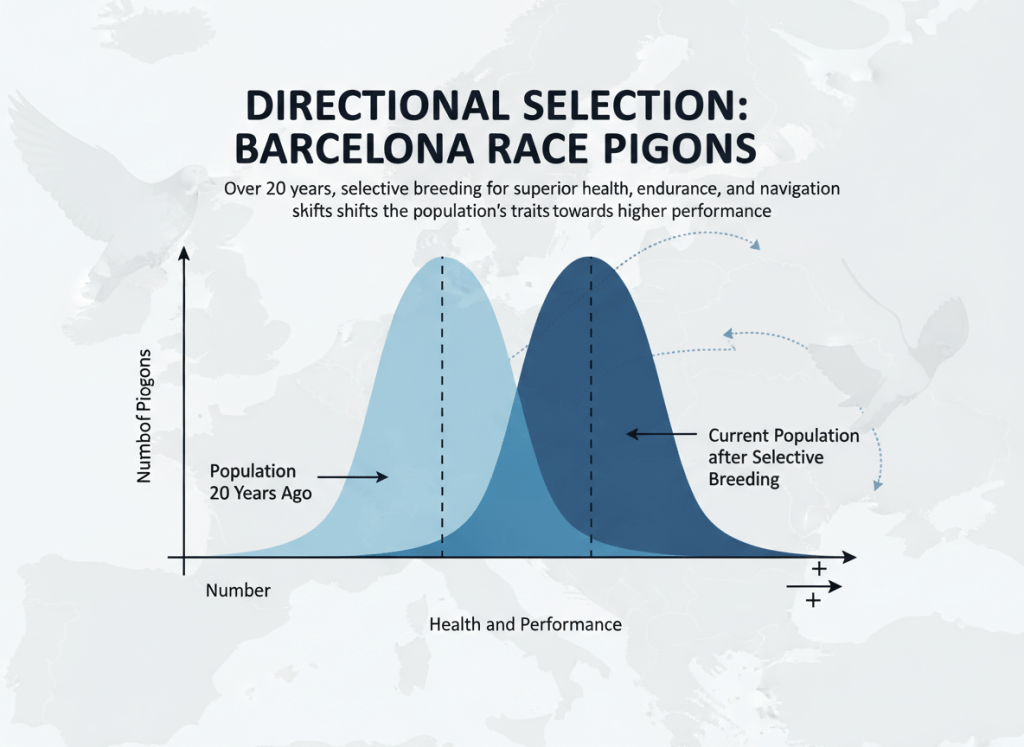
This is not merely a romantic belief among fanciers. It fits perfectly within the biological and statistical logic of directional selection. When breeders select, year after year, for birds that can survive and excel under the extreme demands of Barcelona, the center of the population shifts. In statistical terms, the distribution of performance moves to the right. The median rises, the upper tail becomes more meaningful, and the probability of producing exceptional performers increases over time.
Barcelona is not just a race, but a selection mechanism
The Barcelona race demands something fundamentally different from ordinary speed races. Over shorter distances, a pigeon may still benefit from favorable wind, temporary form, or the dynamics of a group. Barcelona is far less forgiving. It reveals which pigeon truly possesses an internal compass and the mental composure to hold its own line, even when the flock no longer provides guidance. The true Barcelona pigeon is often not simply a fast pigeon, but an individual capable of continuing alone, calmly and decisively, under extreme pressure.
That makes this population especially interesting from both a biological and a statistical perspective. In a normal population, many individuals cluster around the average. Under extreme performance selection, something else happens: the lower end disappears. Not every pigeon that looks healthy is Barcelona-healthy. Not every pigeon that performs well on easier races has the latent capacity to complete a brutal long-distance flight on its own. As a result, over time, the average quality of the breeding population improves not only because the best become better, but because the least suitable individuals are systematically removed from both the racing and breeding pool.
The median often tells us more than the champion
Fanciers naturally speak about first prize winners, national ace birds, and legendary champions in the pedigree. Yet from a statistical point of view, the median may be even more informative than the winner. Why? Because the median tells us what the “typical” pigeon in a family or strain is actually worth.
Imagine that in year one, a loft has a population of Barcelona candidates whose median performance score, on some abstract scale, is 100. If, over the next ten years, the breeder consistently selects only from the top 5% to 10%—and not merely from early arrivals, but from pigeons that remain healthy, recover quickly, repeat performances, and show mental stability—then the distribution begins to move. The median may rise from 100 to 112, 118, or even 125. At first sight, that may not sound dramatic. In population terms, however, it is enormous.
A rise in the median means that the whole population has improved, not merely that a single exceptional bird appeared by chance. That is what distinguishes a genuine Barcelona strain from a family built on one or two fortunate outliers. Luck can produce a winner. A steadily rising median points to inherited and repeatable quality embedded in the line itself.
Selecting out just 5% can reshape a population over ten years
Breeders often underestimate the cumulative power of small but highly disciplined selection decisions. In quantitative genetics, one of the oldest truths is that modest but consistent selection pressure, repeated across many generations, creates major population shifts.
Suppose a breeder removes the bottom half of the population every year. Improvement will occur, but in a broad and rather crude way. But if that breeder instead identifies and breeds only from the top 5%, based on a composite profile—health, recovery capacity, orientation, mental resilience, willingness to continue, and independence—then the breeder is no longer selecting for simple performance. He is selecting for performance under extreme conditions.
This is a classic example of truncation selection: only individuals above a threshold are used for reproduction. But in Barcelona pigeons the threshold is rarely one-dimensional. The breeder is in fact selecting on a multi-trait index. A pigeon that arrives early but collapses in recovery is statistically less valuable than a pigeon that may be slightly less spectacular on one result sheet, but remains healthy, repeats, and produces offspring that do the same. The first pigeon enhances the story. The second improves the population.
Over ten years, even a 5% selection differential can have a profound effect. That is how a family moves from producing occasional Barcelona finishers to producing pigeons for which Barcelona performance begins to feel almost normal.
A pedigree is not decoration; it is a probability structure
When Barcelona racers frequently contain earlier Barcelona performers in their pedigree, that should not be dismissed as coincidence. Statistically, this reflects conditional probability. The probability that a random pigeon can handle Barcelona is limited. But the probability that a pigeon can handle Barcelona, given that several of its close ancestors already did so, is clearly higher.
A pedigree is therefore more than a list of names. It is, in a sense, a historical dataset. Not a perfect one—because failures are rarely recorded with the same enthusiasm—but still a meaningful one. If a family repeatedly contains pigeons that flew Barcelona, returned, remained healthy, recovered, and also bred useful offspring, then the base probability changes. What is rare in the general population becomes less rare within that selected lineage.
Of course, breeders must remain aware of survivorship bias. We mainly remember and display the successful names. The truly skilled breeder understands the silent data as well: which pairings failed to produce resilience, failed to produce recovery, failed to produce mental toughness? The pigeons that do not return, do not recover, or do not repeat also carry information. In statistical terms, those are not empty outcomes. They are negative observations, and they matter.
Health is not a side condition, but the central variable
Performance is often discussed as if health were merely a prerequisite. In Barcelona pigeons, health is much more than that: it is the central underlying variable on which all performance depends. Without superior health, no pigeon can repeatedly excel on Barcelona. But health here should be understood broadly. It includes not only absence of disease, but also metabolic efficiency, muscular recovery, resistance to stress, hydration stability, immune robustness, and the ability to remain mentally clear under prolonged strain.
You might say that the Barcelona pigeon combines low fragility with high persistence. In statistical language, it has a lower probability of breakdown as environmental and physiological load increases. In the vocabulary of survival analysis, its hazard rate—the risk of failing, collapsing, or becoming functionally lost during the race—is lower than that of the average long-distance pigeon.
That makes health a decisive breeding variable. A loft that gradually reduces the variance of negative outcomes while simultaneously shifting the central tendency upward is building something rare: not just brilliance, but reliability. And reliability, over ten years, is far more valuable than a single miracle bird.
Intelligence, confidence, and the ability to fly alone
Perhaps the hardest trait to measure, but one of the most decisive for Barcelona, is independent intelligence. Not intelligence in the human sense, but functional decision-making in the air. The pigeon must repeatedly solve problems: do I follow, do I leave the group, do I correct my line, do I continue alone? This is the dimension that fanciers often describe as “character,” “will,” or “confidence.”
That is what makes the Barcelona pigeon so special. It does not simply carry its body across distance; it carries its decision-making with it. A pigeon that reaches its destination alone, under changing conditions, displays a rare union of orientation, self-possession, and internal certainty. These traits are difficult to measure directly, but their effects appear in the data: more repeatable performances, fewer erratic collapses, better recovery, and greater likelihood that offspring will show similar strength.
In that sense, Barcelona selects not just for stamina, but for a kind of solitary certainty. These pigeons are not merely physically strong enough to continue; they are mentally organized enough to do so without relying on the behavior of others.
After ten years, it is no longer luck but line formation
After one season, one can still talk about chance, weather, or temporary form. After ten years of consistent selection, chance becomes a much weaker explanation. What emerges instead is line formation. The population has changed. Not every pigeon is a champion, but the whole distribution has shifted. The weaker tail has been cut away, the median has risen, the top 10% has become stronger, and the probability that a randomly chosen youngster from that family will possess genuine Barcelona potential is clearly greater than it once was.
This is why the Barcelona racing pigeon is such a compelling example of long-term selection on a complex performance phenotype. What remains after years of disciplined breeding is not an ordinary racing pigeon, but an animal in which health, intelligence, endurance, navigational ability, character, and determination come together in one integrated whole.
 DuijvesteinHattem Netherlands